
The Complete Guide to Choosing the Right Corporate Carpooling Solution for Modern Workplaces
Parking lots are shrinking while fuel budgets keep climbing every quarter. Companies now face a real question. How do we get employees to work without costs spiraling out of control? A corporate carpooling solution answers that question directly. Most platforms treat commuting as an afterthought bolted onto HR software. The right one turns it into a daily win for employees and finance alike. This guide breaks down what makes a platform worth choosing.
Why Workplaces Are Turning to Corporate Carpooling Now
Fuel prices climb every year, and parking space costs more with each passing quarter. A company with hundreds of daily commuters watches these expenses pile up fast. Finance teams now track commute costs as a real budget line, right alongside payroll and facilities.
Sustainability reporting has added its own pressure. Investors want hard numbers backing up every emissions claim a company makes. Workplace carpooling gives companies a clear figure to report each quarter. Fewer cars on the road translate directly into lower emissions. That number flows straight into an ESG report without extra data work on anyone’s part.
Talent expectations play a role here too. Employees want flexibility. A safe, predictable commute ranks higher on their priority list than most companies realize. Ask any HR team about exit interviews. Commute stress comes up constantly. Informal carpool groups run over chat apps break down fast once headcount grows. Someone drops out, the group scrambles, and half the riders drive alone the next morning. Corporate carpooling software fixes that with a clear system and steady tracking. That is not unlike the small, easy-to-miss shortcuts hiding inside everyday workplace software: unremarkable at first, indispensable once you rely on them daily. The hidden features tucked into Slack are a good example of the same idea.
Picture a manufacturing firm running three rotations a day. Manual coordination across those rotations needs a full-time coordinator. Mistakes still slip through. Odd rotation timings make manual matching even harder. Software handles this instantly and skips the spreadsheet errors entirely.
Well-run programs deliver savings that show up in every relevant report. Fuel costs drop. Parking costs drop too. Leadership notices these numbers fast, right next to payroll figures. Finance sees the math laid out clearly. The conversation moves fast after that, from whether to launch to how soon it can go live.
Corporate Carpooling Solution vs. Manual Coordination
Manual coordination and real software look very different side by side.
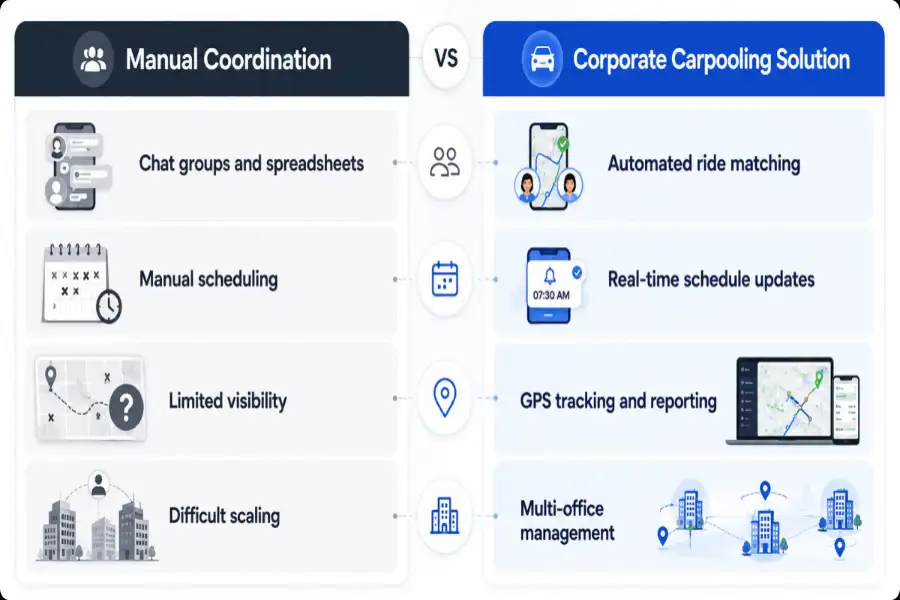
The pattern repeats across every category. Manual methods depend on people remembering things correctly. Software depends on nothing but the data itself.
Must-Have Features in a Carpool Management System
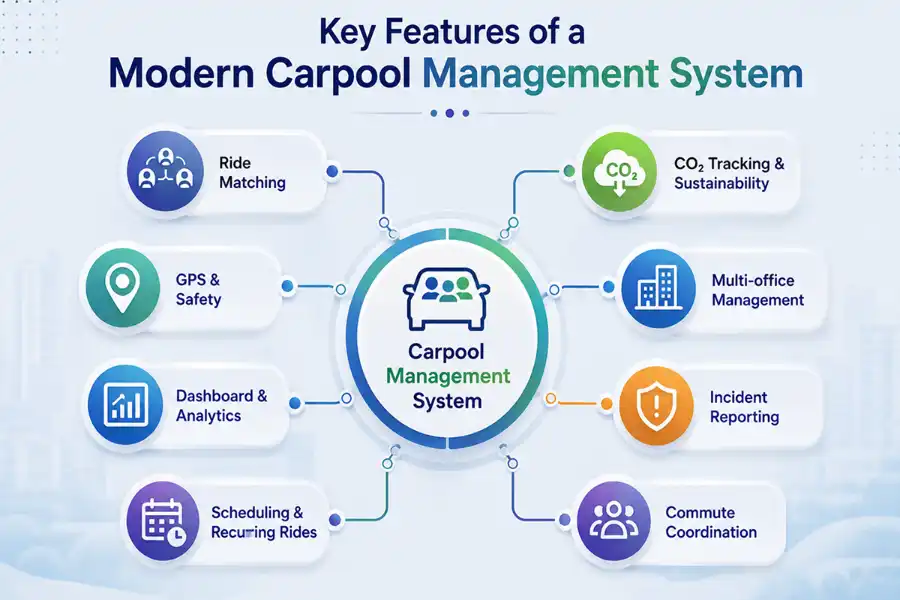
Picking a carpool management system takes real evaluation. A demo shows ten happy users on their best day. Test the platform with five hundred daily users spread across three rotations, on a rainy Monday. Here’s what genuinely separates a strong platform from a weak one.
Smart Ride Matching Engine
Manual coordination breaks down past a handful of employees. Ride matching software pairs riders by route, timing, and department. No coordinator ever touches a spreadsheet. It works on a similar idea to scheduling tools that quietly handle the busywork behind the scenes, the kind of convenience covered in our rundown of Google Calendar tips and tricks, just applied to who sits in which car instead of what goes on your calendar.
- Matches employees by proximity and schedule overlap automatically
- Cuts no-shows through confirmed, algorithm-verified pairings each time
- Adjusts pools instantly whenever schedules or routes change
- Improves match quality over time using historical ride data
Skip this feature, and someone on your team becomes the algorithm by hand. That usually means a spreadsheet nobody enjoys owning. Most stop updating it after the third week.
Real-Time GPS and Safety Tools
Safety drives adoption more than any other feature on this list. Employees commuting home after dark choose carpooling only when they trust the system fully.
- Live ride tracking visible to both riders and administrators
- SOS and emergency support built directly into the app
- Female-only ride options available for added rider comfort
- Verified driver and rider profiles tied to official employee accounts
A rider who feels unsafe even once stops using the program within days. No amount of fuel savings ever brings that employee back afterward.
Admin Dashboard and Reporting
A strong dashboard runs the program largely on its own. A weak one dumps manual reporting work on HR every week. That workload grows as headcount grows. The best dashboards work a bit like the hidden functions tucked inside spreadsheet software: invisible until someone needs them, and genuinely useful once they’re found. Our rundown of Google Sheets hidden functions covers a few worth knowing, and the same find-it-once, use-it-forever logic applies here.
- Centralized view of active pools, incidents, and overall usage
- Historical data and CO2 tracking built for sustainability reporting
- Support for multiple offices, vehicle types, and rider group sizes
- Incident logs that sharpen safety policy decisions over time
Miss any one of these three pillars, and friction shows up somewhere. Maybe employees stop trusting the matches. Maybe admins drown in spreadsheets. Maybe finance can’t pull clean numbers when leadership asks. Pick a platform built around all three from day one.
How to Evaluate a Corporate Ride Sharing Vendor
Corporate ride sharing vendors rarely deliver what the sales pitch promises. Some quote a six-week rollout and take four months to launch. Others promise full data control on the call, then store everything on servers your team never audits. A few pointed questions upfront save months of frustration later.
- How fast does the platform go live once contracts are signed?
- Does it offer white-label branding, or will employees see something generic instead?
- Is deployment cloud based or on premise, and who owns the resulting data?
- Can it scale across additional offices without triggering a full rebuild?
- What does onboarding look like for employees, and does support continue after launch?
Deployment speed and data ownership matter more than most buyers realize. Skip these questions, and friction surfaces six months in, right when leadership expects results. A corporate carpooling solution that takes a full quarter to configure loses momentum fast. Ask vendors how fast a real pilot can go live. A vague answer there reveals almost everything about the relationship ahead.
Beyond deployment speed and data ownership, a handful of criteria separate serious platforms from the rest.
- Multi-shift support for teams running staggered or rotating schedules
- Privacy compliance that meets data protection standards in every region you operate
- Analytics and reporting deep enough to satisfy finance and sustainability audits alike
- Route optimization that adjusts automatically as traffic and rider patterns change
- Driver verification tied to background checks and license validation
- Mobile app quality that riders genuinely want to open every morning
- API integrations with your existing HRMS, so employee data never needs manual entry
A platform missing HRMS integration means someone manually re-enters every new hire and every departure. That work adds up fast across a growing company. Ask vendors to demo each of these live, on a screen share, right in front of you.
Measuring ROI: What Impact Should You Expect?
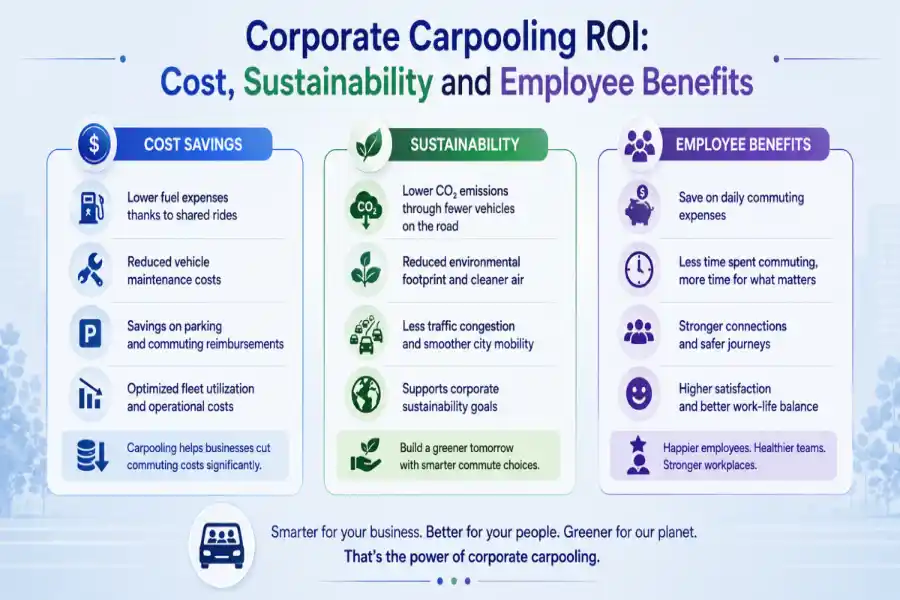
ROI from a carpooling program splits into three parts. Cost, sustainability, and employee experience each carry real weight. Each shows up in a different report.
Cost savings surprise most finance teams the first time they run the numbers. A company with 150 employees running fifty daily pools saves roughly $4,000 a year in fuel alone. Add $10,000 in broader transportation savings. Add $20,000 saved on parking infrastructure that no longer needs expanding. Multiply that across a full year, and the total lands on the CFO’s desk fast.
Sustainability numbers carry similar weight, just in a different meeting. That same 150-person workforce cuts CO2 emissions by roughly 2,400 kilograms a year. That equals saving about 115 trees. Boardrooms respond well to numbers this concrete, especially with a sustainability audit on the calendar.
Employee commute management delivers the harder win to price. Employees arrive calmer and more focused. Punctuality improves across entire teams. Riders feel genuinely safer with GPS tracking and SOS support in their pocket. Ask your own team how their commute affects the rest of their day. The answer usually shows up in engagement scores before finance finishes the cost report.
Getting Started: Rolling Out Carpooling
Launching a program company-wide on day one creates avoidable problems, the kind that cost more time to fix than they would have taken to prevent. Employees get confused about how to join. Admins get overwhelmed fielding questions. Early complaints kill momentum before the program proves its value. A phased rollout holds up far better.
- Pilot the program with one office or department first
- Explain the benefit clearly so employees understand what’s in it for them
- Offer both four-wheeler and two-wheeler options based on local commute patterns
- Use dashboard data weekly to refine pools and adjust routes
- Collect employee feedback early and fix friction points before they harden into habits
A successful pilot builds trust fast. Word travels between departments faster than any internal memo. One department seeing real savings convinces the next one to sign up. Scaling a corporate carpooling solution to more offices gets easier once that trust exists. Momentum carries a program further than any single feature.
How to Increase Employee Adoption
A great platform means nothing if employees never open the app. Adoption takes deliberate incentives on top of good software.
- Offer reserved parking spots for verified carpool riders
- Provide fuel or transit credits tied to consistent participation
- Recognize top carpool teams publicly through internal newsletters or leaderboards
- Waive or discount parking fees for anyone riding with two or more colleagues
- Run a short onboarding session so new hires join within their first week
Leaderboards tap into a small, familiar thrill, the same one that makes people hunt for a hidden Easter egg in a favorite app or game. It’s the fun of finding something extra and wanting to show it off, not so different from the surprise hidden inside Chrome’s Dino game.
Reserved parking works especially well, since it solves a visible daily frustration. An employee who circles the lot for ten minutes every morning notices instantly when carpool riders park closer.
Incentives only work if leadership uses the platform too. Employees watch what managers do more than what policy documents say. A single department head carpooling twice a week does more for adoption than any email announcement.
Track adoption through the dashboard, and adjust incentives based on what genuinely moves participation.
Conclusion
The right platform changes three things that matter to a business. Fuel costs drop. Sustainability numbers improve. Employees stop dreading their daily commute. Strong programs combine smart matching, real safety tools, and dashboards built to drive real decisions. Evaluate vendors carefully, run a genuine pilot, and let the results shape the wider rollout. The right software turns a daily headache into something employees barely think about anymore, one less thing standing between people and a workday that actually runs on time.