
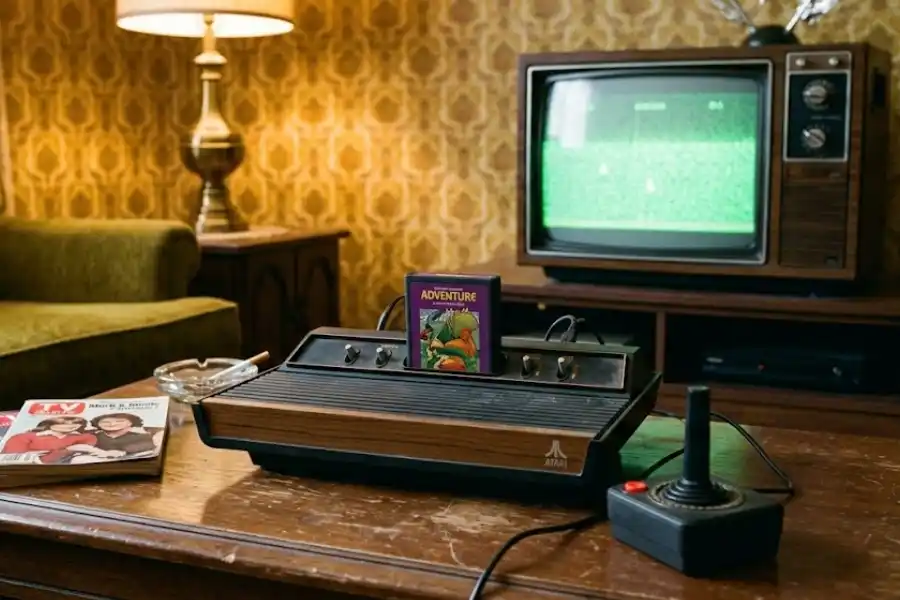
First Video Game Easter Egg: The Secret That Changed Gaming Forever
Back in 1979, a programmer at Atari did something no one had ever done before. He hid his name inside a video game without telling anyone at the company. No permission. No approval. Just a tiny, invisible dot and a secret room that no one was supposed to find.
But someone did find it. A 15-year-old kid playing at home stumbled onto it and wrote a letter to Atari. And just like that, a whole new tradition was born, one that game developers still follow today.
That hidden message is widely known as the first video game easter egg. But here’s the thing most people don’t know: it might not be the first one. There were earlier secrets hiding in older games, years before anyone used the word “easter egg” in gaming.
This article covers the full story. You’ll read about every early easter egg on record, how the term was coined, who started the tradition, and why it still matters more than 50 years later.
What Is an Easter Egg in a Video Game?
Much like a standard software egg, an easter egg in a video game is a hidden feature that developers put in the game on purpose but never tell players about. It could be a secret message, a hidden room, a funny joke, or a small reference to another game or movie. You do not need to find it to finish the game. It’s just there, tucked away, waiting for someone curious enough to stumble onto it.
The name comes from the idea of a real-life Easter egg hunt, where people hide eggs and others go searching for them. That’s what developers started doing with their games. They plant surprises, and players try to track them down.
The term “easter egg” in gaming was coined by Steve Wright, who worked as the Director of Software Development at Atari’s Consumer Division. He used it around 1979 to 1980 after a player found a hidden message inside the Atari 2600 game Adventure. But the practice of hiding things in games started years before anyone gave it a name.
What Was the First Video Game Easter Egg Ever Made?
The earliest known video game easter egg appeared in a 1973 game called Moonlander, created by programmer Jack Burness for the Digital Equipment Corporation (DEC). If you flew your lunar module sideways past several screens, a McDonald’s restaurant appeared on the surface of the Moon.
Most people think the first easter egg was in the Atari game Adventure from 1979. That’s the one that made easter eggs famous and gave them their name. But Moonlander came six years before that.
How Did the Moonlander Easter Egg Work?
The game had a simple goal: safely land your lunar module on the Moon. But Jack Burness programmed something extra that nobody expected.
If you flew your ship sideways long enough, past several screens, you would find a McDonald’s restaurant sitting right there on the Moon’s surface. Land next to it, and your astronaut would hop out, walk over, grab a Big Mac to go, and head back to the ship.
But if you accidentally crashed into the McDonald’s? The game would scold you with a message: “You clod. You’ve destroyed the only McDonald’s on the Moon.”
Nobody used the word “easter egg” for it back in 1973. That term didn’t exist in gaming yet. But looking at it now, this is the oldest known hidden surprise in any video game. McDonald’s even referenced this piece of gaming history in one of their recent marketing campaigns aimed at connecting with gamers.
Were There Other Easter Eggs Before Adventure?
Yes. Between Moonlander (1973) and Adventure (1979), at least two other games contained hidden features that qualify as early easter eggs.
What Was the XYZZY Easter Egg in Colossal Cave Adventure (1976)?
Colossal Cave Adventure was a text-based game created in 1976 by Will Crowther, and later expanded by Don Woods in 1977. You played by typing commands to move through a cave system.
The game contained a secret word: XYZZY. If you typed this word at the right spot, your character would teleport instantly between two locations in the game. This shortcut was never mentioned in the instructions. You had to figure it out on your own or learn about it from another player.
XYZZY became one of the most well-known insider references in programming culture. Software developers still use it as a test placeholder and a nod to early gaming. It’s one of the oldest cheat-code-style secrets on record.
What Was the “Hi Ron!” Easter Egg in Starship 1 (1977)?
Starship 1 was an Atari arcade cabinet game from 1977, built by a programmer named Ron Milner. He left a hidden surprise inside the game that nobody found for 40 years.
If you pushed the arcade cabinet’s buttons in a very specific order, the screen would flash the words “Hi Ron!” and give you 10 extra lives. This easter egg was finally found in 2017, four decades after the game’s original release.
Because it stayed hidden for so long, it didn’t shape gaming culture the way the next easter egg did. But it holds the Guinness World Record for the earliest known easter egg in an arcade game.
Why Is Adventure (1979) Considered the Most Important First Easter Egg?
The Atari 2600 game Adventure, programmed by Warren Robinett in 1979, is considered the most important first easter egg because it gave the entire concept its name. It was the easter egg that made Atari officially recognize hidden secrets in games, and it started a tradition that every game developer knows today.
While earlier games like Moonlander (1973) and Starship 1 (1977) had hidden features too, none of them led to the term “easter egg” or started a company-wide practice. Adventure did both.
Why Did Atari Refuse to Credit Warren Robinett?
Warren Robinett built Adventure for the Atari 2600 entirely by himself. He wrote the code, created the graphics, and designed the gameplay. The game went on to sell over one million cartridges.
But Atari had a strict company policy: no individual programmer’s name would appear on any game.
The reason? Atari was worried. If the public knew which programmer made a hit game, competing companies (like Activision, which was formed by ex-Atari developers in 1979) could recruit them with higher pay. Atari also did not want programmers asking for royalties, which means a percentage of the game’s sales revenue.
This frustrated many Atari developers. They built games that earned millions of dollars, but their names appeared nowhere. Warren Robinett thought this was wrong. So he decided to do something about it, without asking for permission.
How Did Warren Robinett Hide His Name in the Game?
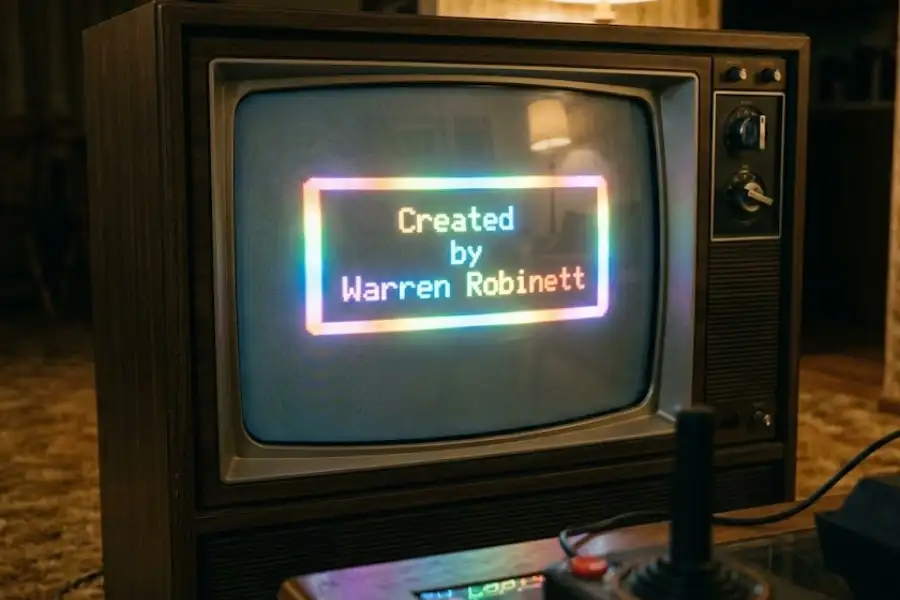
Robinett coded a secret room into Adventure that displayed the text “Created by Warren Robinett” in flashing rainbow colors. But reaching this room required a very specific and complicated series of steps.
He never told anyone at Atari. Not his manager. Not his coworkers. He wrote the code, finished the game, and then left the company before anyone knew the hidden room existed.
The key to the entire secret was an object he created called “The Dot.” It was a single pixel on screen, so tiny it blended in with the room’s walls. Players had to find it, pick it up, carry it across the map, combine it with two other items in a specific room, and then walk through a flickering wall to enter the hidden chamber.
Who Found the Easter Egg in Adventure?
A 15-year-old player named Adam Clayton from Salt Lake City, Utah found the hidden room. He was playing Adventure at home when he stumbled onto the invisible Dot, followed the sequence of steps without any guide, and ended up in the secret room.
He wrote a letter to Atari to tell them what he found.
The people at Atari had no idea the hidden message existed. Robinett had already left the company. No one on the team knew it was in the code. This put Atari in a difficult spot: should they recall the cartridges and remove the message?
Why Did Atari Decide to Keep the Easter Egg?
Atari kept it because removing it would have been too expensive. By the time the secret was found, Adventure had already sold over a million copies. Recalling and replacing those cartridges was not worth the cost.
Instead, Steve Wright, Atari’s Director of Software Development in the Consumer Division, turned it into something positive. He compared the hidden room to finding a prize in an Easter egg hunt, and called it an “Easter egg.”
Wright then encouraged other developers at Atari to start hiding their own surprises in future games. This single decision created an industry-wide tradition that continues today. Every hidden feature in a video game since then can trace its roots back to this moment at Atari.
How Do You Find the Easter Egg in Atari’s Adventure?
You can find the easter egg in Atari’s Adventure by locating a hidden 1-pixel object called “The Dot,” carrying it to a specific room, and walking through a flickering wall. Here are the full steps. You can play Adventure today using emulators, the Atari Flashback consoles, or the Atari 2600+ console.
- Pick the right game mode. You need to play on Game 2 or Game 3. The hidden Dot does not exist in Game 1.
- Go to the Black Castle. Head north from the starting Yellow Castle until you reach the Black Castle area.
- Enter the catacombs. Inside the Black Castle, find the maze area known as the catacombs.
- Look for a flickering room. One of the rooms in the catacombs will flicker on screen. That flicker means there’s a hidden item in there.
- Grab the bridge. You need the bridge item. The bridge lets you pass through walls in the game.
- Use the bridge to open the sealed chamber. In the flickering room, use the bridge to reach a small enclosed space in the lower portion of the room.
- Pick up the Dot. Move your character (a colored square) around the bottom-right corner of the sealed chamber. You’ll hear a pickup sound. You have just grabbed a tiny, nearly invisible object called “The Dot.” It is a single pixel, the same color as the wall.
- Carry the Dot to the right spot. Go to the room directly below the Yellow Castle, then move one screen to the right.
- Bring two other items. Drop two other objects (like keys, the sword, or the chalice) in that same room along with the Dot.
- Walk through the right wall. With three items in the room, the wall on the right side will start flickering. Walk right through it.
- You’re in. You will enter a secret room with flashing rainbow text that reads: “Created by Warren Robinett.”
That’s it. You just found the most famous easter egg in video game history.
How Have Video Game Easter Eggs Changed Over the Years?
Easter eggs started as simple hidden messages in the 1970s and have grown into complex, interactive secrets that sometimes take players years to find. Here is how they evolved decade by decade.
1970s: Hidden Messages and Developer Credits
The earliest easter eggs were small and simple. A hidden name here, a secret word there. Developers mostly hid them because their companies refused to give them public credit. These little surprises were quiet acts of rebellion by programmers who wanted recognition for their work.
1980s: The Rise of Cheat Codes
The Konami Code became the most recognized gaming secret of this era. In 1986, developer Kazuhisa Hashimoto added the input sequence Up, Up, Down, Down, Left, Right, Left, Right, B, A to the NES version of Gradius as a testing shortcut. He forgot to remove it before the game shipped. Players found it, shared it, and the Konami Code became one of the most famous cheat codes of all time. Dozens of other games adopted it after that.
1990s: Hidden Rooms, Developer Jokes, and Bold Surprises
Easter eggs got bolder and bigger. In Doom II (1994), developed by id Software, players found a hidden room behind the final boss. Inside was the severed head of lead developer John Romero mounted on a stick. A backwards audio message played: “To win the game, you must kill me, John Romero.” It was bizarre, funny, and became legendary in gaming circles.
2000s: Pop Culture References Become the Standard
Games like Rockstar’s Grand Theft Auto series and Nintendo’s The Legend of Zelda franchise started filling their open worlds with references to movies, TV shows, and other game series. Finding easter eggs became a community hobby. Players began sharing their findings on internet forums, wikis, and early YouTube videos, helping each other hunt for secrets across entire game maps.
2010s and Today: Entire Experiences Hidden Inside Games
Modern easter eggs are much bigger than a hidden message on a wall. Batman: Arkham Asylum (2009), developed by Rocksteady Studios, hid blueprints inside the game that teased the sequel Arkham City. Nintendo’s The Legend of Zelda: Breath of the Wild (2017) included a quiet tribute to late Nintendo president Satoru Iwata. Rare’s Sea of Thieves honored a late player with a hidden in-game memorial called “Glitterbeard.” Some of these secrets are so carefully hidden that they take years, sometimes even decades, before anyone finds them.
Did the First Video Game Easter Egg Appear in Popular Culture?
Yes. Warren Robinett’s hidden room in the Atari 2600 game Adventure became a central plot point in both the novel and movie Ready Player One.
In 2011, author Ernest Cline published Ready Player One, a science fiction novel set in a virtual world called the OASIS. The story follows a teenager competing to find a hidden easter egg left by the virtual world’s creator. The book directly references Robinett’s Adventure easter egg as a major part of the plot. The entire treasure hunt in the story was built on the same idea: hidden secrets in games, placed there for sharp-eyed players to find.
Director Steven Spielberg adapted the book into a film in 2018. The Adventure easter egg scene became one of the most recognized moments in the movie, introducing Robinett’s story to millions of people who had never played the original Atari game.
The book, the movie, and the worldwide conversation around them all trace back to one frustrated programmer in 1979 who wanted people to know he built the game they were playing.
The Earliest Known Video Game Easter Eggs: Side-by-Side Comparison
| Year | Game | Platform | Easter Egg | Creator | When Found |
|---|---|---|---|---|---|
| 1973 | Moonlander | DEC GT40 (mainframe) | A hidden McDonald’s restaurant on the Moon | Jack Burness (Digital Equipment Corporation) | Around the time of release |
| 1976 | Colossal Cave Adventure | PDP-10 (mainframe) | The secret teleportation word “XYZZY” | Will Crowther | Around the time of release |
| 1977 | Starship 1 | Atari arcade cabinet | “Hi Ron!” message plus 10 extra lives | Ron Milner (Atari) | 2017, forty years after release |
| 1979 | Adventure | Atari 2600 (home console) | “Created by Warren Robinett” hidden room | Warren Robinett (Atari) | Around 1980, by 15-year-old Adam Clayton |
Frequently Asked Questions
What was the first video game easter egg?
The earliest known video game easter egg is from Moonlander (1973), where programmer Jack Burness hid a McDonald’s restaurant on the Moon. But the most famous first easter egg is from Atari’s Adventure (1979), where Warren Robinett hid a secret room showing his name. The Adventure easter egg is the one that gave hidden game secrets the name “easter egg.”
Who created the first video game easter egg?
Jack Burness created the oldest known easter egg in Moonlander (1973) while working at the Digital Equipment Corporation. Warren Robinett created the most recognized first easter egg in the Atari 2600 game Adventure (1979). Robinett’s hidden message is the one that kicked off the entire easter egg tradition in the gaming industry.
Why did Warren Robinett hide his name in the game Adventure?
Atari’s company policy would not allow any individual programmer’s name to appear on a game. They were concerned that if developers became known publicly, competitors like Activision would hire them away or they’d demand royalties. Robinett built the entire game by himself and thought this no-credit rule was unfair, so he secretly coded his name into a hidden room as a way to claim credit for his own work.
Where does the term “easter egg” come from in gaming?
Steve Wright, who held the title of Director of Software Development at Atari’s Consumer Division, came up with the name around 1979 to 1980. After a 15-year-old player named Adam Clayton from Salt Lake City found Robinett’s hidden message in Adventure and reported it, Wright compared the find to an Easter egg hunt. He encouraged other Atari developers to hide similar surprises in their games going forward. The name caught on across the entire gaming industry and is still used today.
How do you find the easter egg in Atari’s Adventure?
Play on Game 2 or Game 3 (the Dot does not appear in Game 1). Go to the Black Castle catacombs, find a flickering room, and use the bridge item to enter a sealed chamber. Pick up a tiny invisible object called “The Dot.” Carry it to the room below the Yellow Castle, go one screen to the right, and bring two other items into that room. The right wall will start flickering. Walk through it to find a secret room that says “Created by Warren Robinett.”
Is the Adventure easter egg in Ready Player One?
Yes. Ernest Cline’s 2011 novel Ready Player One and its 2018 film adaptation directed by Steven Spielberg feature Warren Robinett’s Adventure easter egg as a central plot point. The entire treasure hunt story is built around the idea of a hidden secret inside a game, directly inspired by what Robinett did with the Atari 2600 game Adventure in 1979.
What is an easter egg in a video game?
An easter egg in a video game is a hidden feature placed in the game on purpose by its developers, without telling players it exists. It might be a secret room, a funny message, a reference to another game or movie, or a surprise interaction. Easter eggs are not needed to complete the game. They are bonuses placed there for curious players to find on their own. The term was coined by Steve Wright at Atari around 1979 to 1980.
Why the First Video Game Easter Egg Still Matters Today
Warren Robinett did not set out to start a lasting tradition. He just wanted his name on the game he built with his own hands. But that one small act of defiance, hiding a single pixel, building a hidden room, coding a glowing message, reshaped how the entire gaming industry thinks about secrets in games.
Before Robinett, games were just software on a shelf. After him, they became treasure maps. Every new release was a chance to look harder, check every corner, and find something nobody else had found yet.
That habit is still alive right now. Every time a developer tucks a secret into a game and a player tracks it down, they are both continuing something that started with a frustrated programmer, a company that refused to give him credit, and a dot so small you could barely see it on a TV screen in 1979.
The first video game easter egg was more than a hidden message. It was a programmer saying, “I made this, and I want you to know.”