
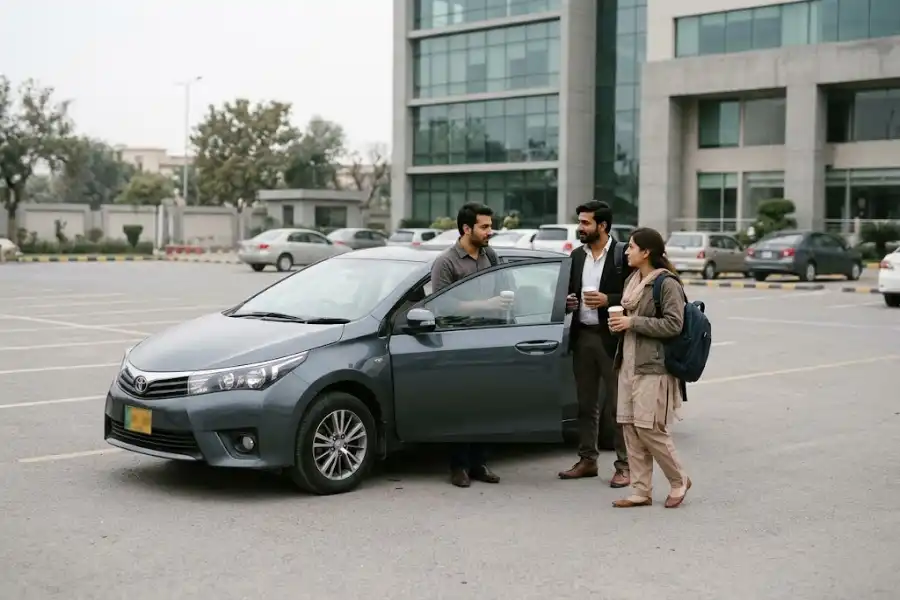
Corporate Carpooling That Actually Works: Adoption, Incentives, and Technology
Most corporate carpool programs launch with a healthy signup list and a communications plan, and then eventually stop being mentioned. Six weeks in, the app might have four hundred registered employees but just eleven pooled trips a day. Nobody cancels the program, because cancelling would mean stating out loud that it was supposed to work but didn’t. It simply stops appearing in the monthly review.
The usual problem is diagnosed to be culture. Employees like their own cars, they value their privacy, and find it difficult to commit to a fixed timing. Yet, the same workforce fills a 44-seater shuttle every morning without complaint. What separates the two is whether a match exists the moment somebody looks for one.
So the real problem is supply. When enough colleagues live nearby and travel on the same days and timings, carpooling works. When they do not, carpooling cannot work.
What makes corporate carpooling work?
Four things, in this order:
- A dense matching pool: An employee searching for a ride should find one on the first attempt.
- Incentives paid in time: Parking and incentives do move behaviour.
- A constraint-aware matching engine: Detour limits and safety rules have to be hard rules, not preferences.
- Matched trips are the metric: Registrations tell you nothing about whether anybody pooled.
Each section below covers one of those.
Why carpool pilots die quietly
Carpooling depends on a network effect, and network effects decay quietly.
A thin pool produces failed searches, and over time failed searches mean fewer searches in total. Within a month the pool is thinner than it was at launch.
The pool is not thin because people stopped coming in. MoveInSync’s India on Wheels 2026 data shows:
- Employees commute to the office an average of 3.8 days a week.
- Tuesday has the peak attendance, with attendance above 98% on Thursday, easing to 86% on Friday
- The average one-way commute reached 64 minutes and 22 km in 2025, up 6.7% in a year, as people travel in from wider geographies
So attendance is not the constraint, but geography is. People travel further now, from addresses spread wider than the routes were built for, and that is what employee transport solutions have to put back together.
Adoption is a density problem
Overlap means the number of employee pairs who share a corridor, a shift window and a day that they commute to office. That is your matching pool, not your headcount, and it shrinks fast when any one of the three changes.
Three changes can widen the pool:
- Launch narrow: Start on the two or three corridors with the highest employee density. A 60% first-search match rate in one corridor produces more trips, and far more word of mouth, than 8% everywhere.
- Start with the busiest days: Attendance already concentrates midweek, so that is when the pool is at its densest and a search is most likely to succeed. Promote pooling on those days first and let the quieter days follow once people have had a good experience.
- Move the pickup point: Asking riders to walk two minutes to a nominated corner finds matches better than door-to-door routing. Riders can check that walk themselves, and a few of the Google Maps hidden features, such as measuring distance on the map, make it a ten-second check.
Detour tolerance is the fourth dial, and it belongs to the host. The further a host agrees to go off route, the more people they can be matched with, but that also means that their own drive gets longer. Let hosts set that limit themselves rather than picking one for them.
Incentives that trade in time
The strongest evidence in commuter behaviour concerns parking, and it has held up across decades of employer programs.
Across eight California employers that cashed out subsidised parking, solo driving fell 17% and carpooling rose 64%.
The EPA’s employer-based incentives review reports 34% to 37% lower peak-hour traffic and 17% to 24% lower peak parking demand across nine Minneapolis office buildings running full plans.
Cash by itself performs badly. A field experiment across 537,000 commuters in four US states found a $10 welcome bonus had no statistically significant effect on participation, while messaging that led with High Occupancy Vehicle lane access lifted click-through by 133% to 185% among people who stood to save real time.
Time is the currency employees respond to, because a minute saved on the commute is a minute handed back to their day. A small payment reads as compensation for an inconvenience, which is an unhelpful thing to imply about a program you want people to enjoy.
The technology’s real job
Plenty of companies already run carpooling on a WhatsApp group, and it works only for about a fortnight. It probably looks something like this: somebody posts a route, two people reply, and the group turns into a scroll nobody reads. There’s no way of recording who travelled with whom, nobody verifies the driver, cost sharing depends on memory, and nobody can tell whether it reduced the number of cars arriving at the office. Moving the same chat into Slack does not change that, since even a scheduled reminder from one of the Slack hidden features only keeps the thread alive a little longer.
A platform earns its place by closing those gaps. Three layers decide whether employees use it:
- The constraint model: The engine has to hold every rule at once: who lives where, when each shift starts, how far a host will drive off route, how many seats the car has, and what the law requires. If a match breaks any of them, it ends up as a support ticket.
- Verification: Verified driver and rider identity, live GPS tracking, an in-app SOS and a confirmed drop for every occupant are what make it reasonable to put two colleagues in one vehicle at 10pm. The same records would then help you settle payouts, parking entitlements and billing against trips that ran. If any of this stays manual, both the safety promise and the incentive scheme are simply running on trust.
- The request flow: Every extra step between wanting a ride and holding a confirmed seat costs you matches. Offering a seat should take as few taps as possible, a request should come back with real matches rather than a place in a queue, and the rider should see who they are travelling with and what the detours are involved before they accept.
Pooling also cannot be planned in isolation, which is why the better employee transport solutions run it as a module of the transport stack rather than instead of it.
MoveInSync offers pooling with the same routing engine as cabs and shuttle solutions and proves real reduction in transport cost with its transport management platform.
What to watch every week
- First-search match rate: Whether the pool is dense enough to be worth opening.
- Matched trips per week: Whether anything is happening, as against registrations rising.
- Repeat pooling after eight weeks: Whether the experience held up once the novelty wore off.
- Average detour minutes per rider: What the match is costing the people in the car.
- Carbon emission per employee-kilometre: What pooling contributes to Scope 3 reporting.
Read each by day type, not as a weekly average. A match rate that looks healthy overall is usually carried by Tuesday to Thursday and is weaker at either end of the week. If these numbers live in a spreadsheet, a few Google Sheets hidden functions and keyboard shortcuts make splitting them by day type a matter of minutes.
Conclusion
Corporate carpooling rewards concentration over reach. Pick the densest corridors first, start with the days attendance is already high, let riders set their own detour limit, and incentivise them in parking and time saved, rather than vouchers alone. Then verify every trip, so the safety promise and the billing both hold, and the time saved is easy to point to.
If you are starting out, run a six-week pilot on one corridor and watch two numbers: how often a search returns a match, and how many people who pooled once pool again. Put the weekly review in a recurring calendar slot so those numbers get read, and the Google Calendar tips and tricks show how to set that up in a minute or two.
Most carpool programs do not fail because employees refuse to share a ride. They fail because there was nobody to share it with, and that is a planning problem rather than a persuasion problem.