
Triangle Peg Game: Rules, Strategy, and How to Win
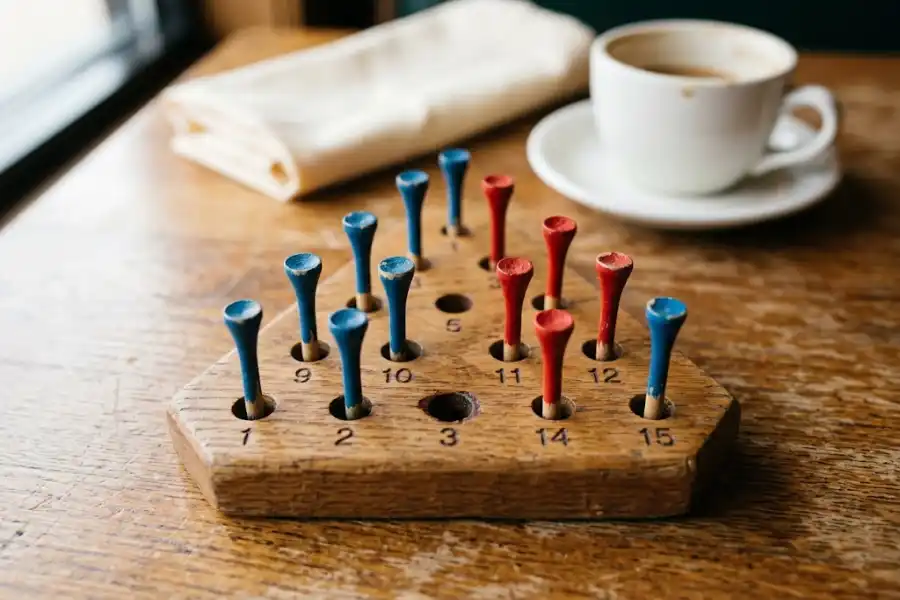
You have probably seen it before. A small wooden triangle sitting on a restaurant table, with tiny golf tees stuck in little holes. It looks harmless. Almost boring. Then you pick it up, jump one peg over another, and suddenly you are stuck for the next twenty minutes trying to figure out where you went wrong.
That little wooden triangle is called the triangle peg game, and it has quietly humbled millions of people while they waited for their food to arrive. It looks like a toy for kids. In reality, it is one of the sneakiest logic puzzles ever made.
In this article, we will break down what the game is, how to play it the right way, and the simple strategy that actually works. By the end, you will understand why this tiny puzzle has survived for hundreds of years.
What Is the Triangle Peg Game?
The triangle peg game is a puzzle board shaped like a triangle. It usually has 15 holes and 14 pegs. One hole is left empty at the start.
The rule is simple: you can only move a peg by jumping it over another peg into an empty hole, just like checkers. Every time you jump, you remove the peg you jumped over. The goal is to keep jumping until only one peg is left on the board.
Sounds easy, right? It is not. Most people finish with four or five pegs still stuck on the board, wondering how everyone else seems to solve it so fast.
A Short History You Probably Didn’t Know
This puzzle is much older than most people think. Its roots go back to a game called peg solitaire, which was played in France as early as the late 1600s. Back then, boards were often shaped like a cross instead of a triangle.
The triangle version became especially popular in American restaurants during the 20th century. Diners would keep the small wooden boards on every table to entertain guests while they waited for their meals. It served the same purpose long before phones took over that job, in the same way the Chrome Dino Game keeps people entertained today whenever their internet connection drops and a webpage refuses to load. Many boards even came with a card that “graded” your intelligence based on how many pegs you had left. It was never a real IQ test, but it made the game feel like a personal challenge every single time.
How to Play the Triangle Peg Game (Step by Step)
- Set up the board with 14 pegs filled in and one hole left empty.
- Find a peg that sits right next to the empty hole, in a straight line.
- Jump that peg over another peg and land it in the empty hole.
- Remove the peg you just jumped over from the board.
- Keep repeating this process, always jumping over one peg into an empty space.
- Stop when you cannot make any more legal jumps.
- Count how many pegs are left. One peg means you solved it perfectly.
The Secret Strategy Nobody Tells You
Most beginners lose because they play too fast. They make the first jump they see instead of thinking ahead. Here is what works.
- Think two moves ahead, not one. A jump that looks good right now might block every other move later.
- Watch for lonely pegs. If a peg gets isolated with no neighbor close by, it can never be removed. Avoid creating these early.
- Clear the center first. Pegs in the middle of the triangle give you more directions to jump, so clearing space there opens up more options.
- Save the corners for last. Corner pegs only have a couple of possible jump directions, so they are easier to deal with once the board is emptier.
- Restart without guilt. Even skilled players restart the puzzle several times before finding the winning path. That is normal, not failure.
Why Does This Simple Game Feel So Hard?
The triangle peg game feels hard because your brain cannot hold every possible outcome in your head at once. Each jump changes the board completely, and one wrong move early on can quietly ruin your chances ten moves later without you even noticing.
This is called a combinatorial puzzle. In simple words, that means there are hundreds of possible paths, but only a few of them lead to success. Your brain has to plan ahead instead of just reacting, and that kind of thinking takes practice.
A good puzzle does not test your knowledge. It tests your patience.
Fun Facts About the Triangle Peg Game
- There is no single “correct” solution. Depending on which hole starts empty, several different winning paths can exist.
- Mathematicians have studied peg solitaire for centuries because it connects to graph theory and pattern logic.
- The classic wooden version with golf tees became a staple in American diners largely because it was cheap, small, and endlessly replayable.
- Some digital versions of the game now exist as mobile apps, but many players still say the wooden version feels more satisfying. It joins a long list of small bonus games hidden inside everyday technology, including the hidden game built into Android phones that most users never think to look for.
- If tucked-away puzzles are your thing, the hidden jigsaw puzzle inside VLC media player is a fun modern cousin of this classic wooden challenge.
Common Mistakes Beginners Make
- Jumping the first available peg instead of scanning the whole board first.
- Ignoring pegs near the corners until it is too late to save them.
- Trying to solve it in one attempt instead of restarting after a mistake.
- Forgetting that every jump removes a peg permanently, with no way to undo it once it’s gone.
Frequently Asked Questions
Is there a trick to win the peg game every time?
There is no single trick that guarantees a win on the first try, but planning two or three moves ahead dramatically improves your odds. Clearing the center early and saving corner pegs for later is the closest thing to a reliable strategy.
What does it mean if you leave four pegs?
In restaurant tradition, leaving four pegs was often labeled as “just plain dumb” on the little scorecards. It was always meant as a lighthearted joke, not a real measurement of intelligence.
Can the triangle peg game be solved with math?
Yes. The game has been studied using combinatorics and graph theory, and researchers have mapped out which starting positions can lead to a single remaining peg. It is a real, well-documented puzzle in mathematics, not just a restaurant toy.
Final Thoughts
The triangle peg game proves that you don’t need flashy graphics or complicated rules to create a puzzle that sticks in someone’s mind. A handful of wooden pegs and a triangle board is all it takes to turn a five-minute wait into a genuine mental challenge. If this kind of quiet, offline brain teaser appeals to you, the Tetris game hidden inside the Mac terminal offers a similar retro challenge for patient minds.
Next time you spot one sitting on a table, don’t just glance at it. Pick it up, plan your first few jumps carefully, and see how close you can get to that single winning peg.